Christensen Institute in the Media
Researchers at the Clayton Christensen Institute for Disruptive Innovation regularly contribute insights to leading national and global media outlets on topics including Disruptive Innovation, education innovation, global prosperity, and health care transformation.

Christensen Institute research and commentary have been featured in more than 100 media outlets worldwide, including:
The Atlantic · The New York Times · Harvard Business Review · The Economist · The Washington Post · Fast Company · NPR · Bloomberg · Stanford Social Innovation Review · The Wall Street Journal











Featured Coverage
A selection of notable media coverage highlighting the Institute’s research and thought leadership.

Fast Company
Julia Freeland Fisher & Ann Somers Hogg on the ethics of Disruptive Innovation
January 27, 2026
“In this world where disruption is inevitable, the question isn’t whether AI will reshape our lives. It’s whether we will summon the foresight—and the moral compass—to ensure it doesn’t disrupt our humanity.”

The Atlantic
“The Right Way to Look for a New Job”
A deep dive into Michael B. Horn and Bob Moesta’s book, Job Moves
January 16, 2025
“[Michael B. Horn and Bob Moesta’s] new book, Job Moves, documents the experiences of hundreds of job changers, and finds that their switches are motivated largely by one of four ‘quests.’ Your principal job dissatisfaction probably falls under their schema—just as one of their quests may fit how you should assess a new opportunity.”

New York Times
“Every Tech Tool in the Classroom Should Be Ruthlessly Evaluated”
Julia Freeland Fisher on evaluating technology and its impact on relationships
April 24, 2024
“I’m convinced that when it comes to the proliferation of tech in K-12 education, we need ‘a hard reset,’ as Julia Freeland Fisher of the Christensen Institute put it, concurring with Jonathan Haidt in his call for rolling back the ‘phone-based childhood.’ When we recently spoke, Fisher stressed that when we weigh the benefits of ed tech, we’re often not asking, ‘What’s happening when it comes to connectedness and well-being?'”

HARVARD BUSINESS REVIEW
“Don’t Just Pay Interns, Help Them Build Networks”
Julia Freeland Fisher on internships and career readiness
May 23, 2022
“If internships are going to operate as engines that promote inclusion rather than perpetuate inequality in the labor market, compensating interns with both financial and social capital matters. Calls to expand access to internships, especially paid ones, are well-intentioned. But they’ll fail to deliver on their full potential without a careful eye on who students get to know along the way.”

THE ECONOMIST
“How covid-19 is inspiring education reform”
Thomas Arnett on online learning and classroom innovation
June 23, 2021
“Thomas Arnett…says that, well before covid-19, teachers were realising that material delivered to a whole class at the start of lessons might be taught through videos provided in advance. This kind of shift would minimise the amount of classroom-time teachers spend lecturing and maximise the time they could spend helping pupils apply knowledge they have already acquired.”
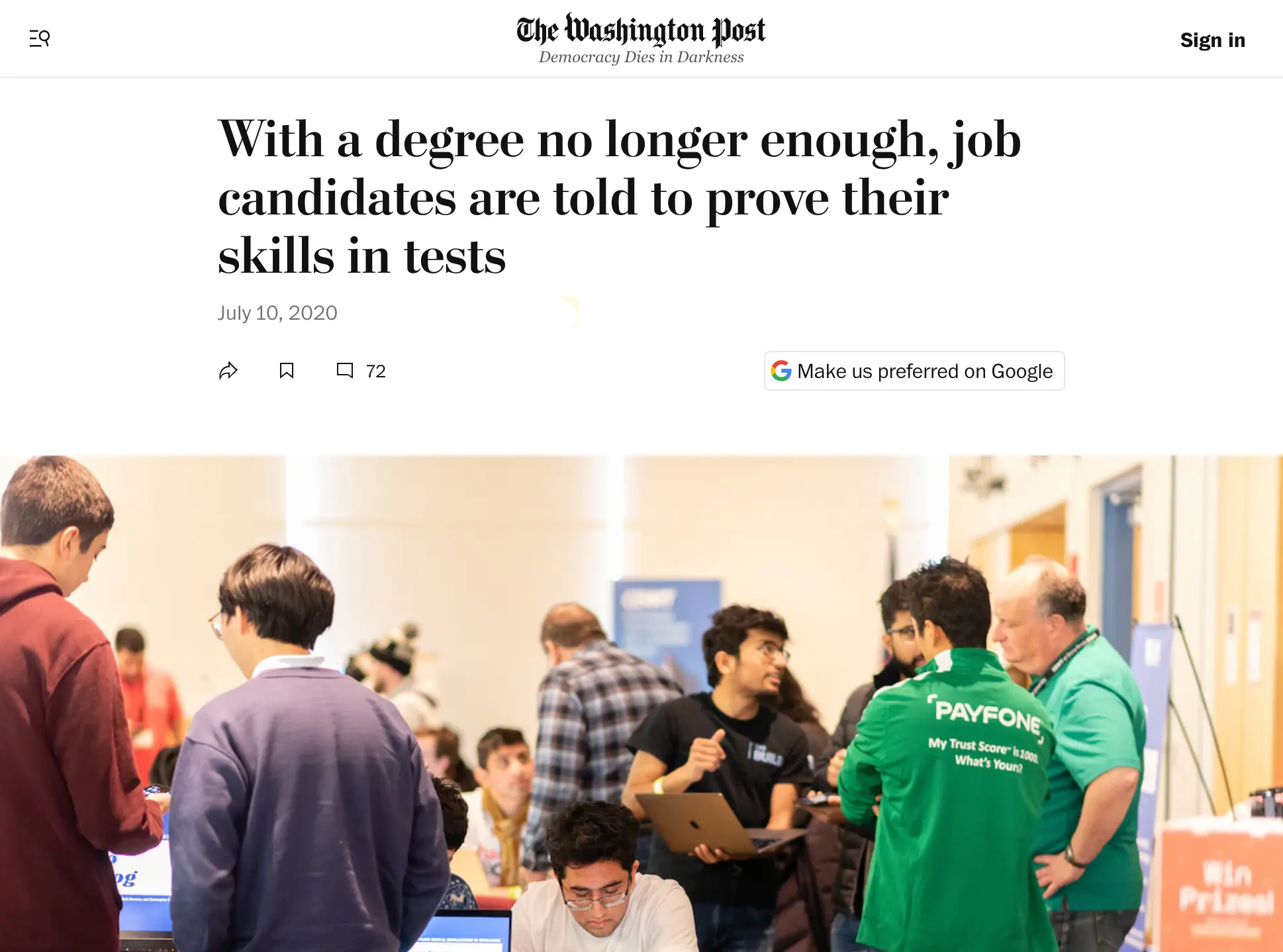
THE WASHINGTON POST
“With a degree no longer enough, job candidates are told to prove their skills in tests”
Richard Price on job skills in a changing economy
July 10, 2020
“…a trend toward ‘pre-hiring assessments’ — already underway before the novel coronavirus swept through the country — is getting a huge push. With so many applicants, ‘you need filters,’ said Richard Price, a research fellow at the Christensen Institute, which studies innovation. “You’re creating a quasi-audition for jobs.”
Selected Media Mentions by Research Area
Expert Perspectives
Journalists frequently seek perspectives from Christensen Institute researchers on innovation, education, health care, and economic development.

Julia Freeland Fisher
Director of Education Research
On students’ social capital:
“Access to opportunity isn’t just about what students know. It’s about who they know—and whether schools and colleges are helping students build and mobilize those relationships.”
On AI and connection:
“We don’t just need to make AI companions less amenable to people. We need to make the market less amenable to AI companions. To do that, we need a whole host of prosocial policies and technologies.”

Thomas Arnett
Senior Fellow, Education Research
On technology and teaching:
“Technology will never replace teachers outright, but it could and should reshape how schools and classrooms can organize teaching and learning.”
On alternative school models:
“Microschools and alternative models of schooling aren’t merely running a program; they’re solving the deeply felt struggles that families experience as they try to do what’s best for their children. For many families, these programs are a refuge.”

Efosa Ojomo
Director, Global Prosperity Research
On creating prosperity:
“Prosperity doesn’t come from aid alone—it comes from innovations that make essential goods and services affordable to millions who previously lacked access.”
On entrepreneurial potential:
“Nonconsumption occurs when someone is unable to purchase and use a product or service that could address an important need due to factors like cost, inconvenience, and complexity. For savvy entrepreneurs, these untapped markets spell immense opportunity.”

Ann Somers Hogg
Director, Health Care Research
On health care transformation:
“Health care reform is about redesigning systems to deliver better outcomes at lower cost, not just payment models.”
On maternal health:
“If health is wealth, America’s working mothers are living in extreme poverty. The first step in improving working mothers’ health outcomes is for forward-thinking employers to institute policies and workplace benefits that promote maternal health, not detract from it.”
Media Contact
For interview requests, speaking opportunities, or media inquiries:
Contact Vice President of Communications, Meris Stansbury: meris@christenseninstitute.org