Every major technology has promised and delivered progress along a primary dimension. AI promises multi-dimensional progress. If entrepreneurs and policy makers harness its power well, it could unleash unparalleled prosperity. If not, it will not only exacerbate inequality but also disrupt work and society.
Over the coming years, leaders in technology, government, and academia will continue to debate the merits and risks of an AI-driven future. Will it overpromise and underdeliver? Will it destroy more jobs than create? Will it disrupt society as we know it or unlock unprecedented prosperity?
As with most technologies in their infancy, consensus will be elusive. Many once believed the automobile was a fad, and that the television would not last because people would “get tired of staring at a plywood box every night,” according to a former industry executive.
In the case of AI, however, its value proposition appears fundamentally different from that of any prior technology humanity has adopted.
Defining technology
For our purposes, let’s define it as the process by which inputs of lower value are transformed into outputs of higher value. That definition is not only clear, but it also helps us see that technology can be hightech, lowtech, digital, analog, and so on.
Examples of different technologies and the primary value they provide
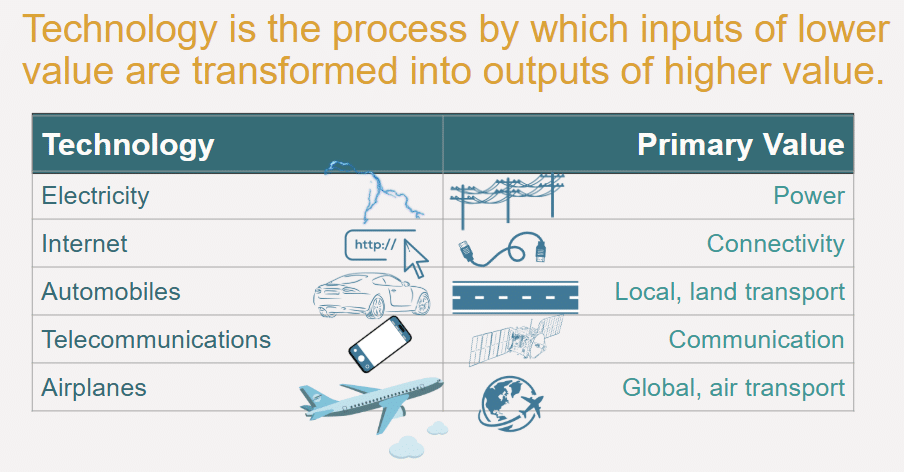
With prior technologies, from electricity to the Internet, the value these technologies have provided has been relatively specific. Electricity provides power; the Internet’s value is connectivity; fire provides heat and light; steel provides structural integrity due to its immense strength and durability. Each of these technologies can be applied to different things, but their value is the same. As valuable as the Internet is, it doesn’t provide power. And as important as electricity is, it does not offer connectivity.
In one sense, technology makes us superhuman. It enables us to do things that are beyond our human capabilities. It enables intercontinental travel, construction of skyscrapers, instant communication across continents, and the ability to store, process, and analyze vast amounts of information far beyond what any individual mind could hold.
AI is different in kind and in degree.
Artificial intelligence offers both intelligence and the automation of intelligence, the primary input to every other technology created. Consider this. Google’s DeepMind is building an automated science lab in the UK. The lab will direct “world-class robotics to synthesize and characterize hundreds of materials per day” in the hopes of shortening the time it takes to identify new materials. This is different from automating an activity in a manufacturing plant where one needs to produce one million of the same (or similar products). This is automating the discovery and development of new materials, an activity previously attributed primarily to humans.
When AI is paired with robotics, as we see in DeepMind’s labs, it becomes clear that this combination will not only generate new technologies but also reshape the nature of work itself.
Much has already been written about AI’s impact on work. Some say it is already having a significant impact on the labor market. Others suggest that AI can’t replace you at work. Essentially, work is an interdependent combination of both automatable and non-automatable tasks. Yet more think an AI bubble is brewing.
A central question in this debate is whether AI will replace work or augment it. Researchers at Harvard Business School and Hong Kong University of Science and Technology suggest that, “generative AI driven automation reduces labor demand and skill requirements in structured cognitive-task jobs, while increasing both demand and skill complexity in positions that involve human-AI collaboration.” In effect, it depends. But what does Disruptive Innovation theory predict will happen?
What disruptive innovation theory predicts
In 1947, Bell Labs invented the transistor, a solid-state device that was far smaller, cheaper, more durable, and more energy-efficient than vacuum tubes, which had powered radios since the 1920s. Early transistors were inferior in sound quality and power, so incumbents dismissed them. But in 1954 companies like Regency introduced the first transistor radios, which were portable, battery-powered, and affordable for teenagers and mass consumers. As transistor performance rapidly improved through the late 1950s and 1960s, they overtook vacuum tubes on mainstream performance dimensions, ultimately displacing them entirely and enabling not just modern radios, but the broader semiconductor revolution that followed.
In the 1960s, steel minimills entered the market producing low-quality rebar using electric arc furnaces, a segment that integrated steelmakers were happy to abandon because it offered low margins. Over time, minimills steadily improved quality and scale, moving upmarket into structural beams and eventually flat-rolled and sheet steel by the 1990s and 2000s, displacing integrated producers in their core markets. What began as a marginal, inferior technology ultimately reshaped the entire steel industry.
In the late 1990s, Netflix began as a DVD-by-mail service serving a fringe market that Blockbuster dismissed as niche and unthreatening. By the late 2000s, Netflix moved upmarket into streaming, then into original content in the 2010s, ultimately displacing incumbents across distribution and production. Today, the fact that there has been serious market speculation about Netflix acquiring a legacy giant like Warner Bros. Discovery is a striking reminder of how a once-laughed-at entrant can grow to challenge, and potentially absorb, the very incumbents it once depended on.
Today, AI tools like ChatGPT and other generative AI systems such as Gemini are being adopted first for narrow, assistive tasks that many organizations still view as experimental or nonessential. As their capabilities improve and costs fall, they will move upmarket and reshape core workflows, decision-making, and production across industries. Over time, what now feels like a helpful add-on will become foundational infrastructure for how work is organized and value is created.
In the same way it was difficult to predict the improvement trajectory of transistors, mini-mills, and Netflix’s offerings, it’s equally difficult to predict the improvement trajectory of AI tools. But disruptive innovation theory predicts that powerful incentives, such as cost reductions, new markets, and competitive pressure, will continue to drive investment to improve these tools, ultimately pushing them upmarket until they reshape core activities and displace incumbent approaches.
Whether this transition leads to broad-based prosperity or concentrated gains will depend less on the technology itself than on the institutions and incentives that shape its deployment. That, to me, is the most important consideration.