Summary:
- Aid budgets will shrink, rewarding development organisations that innovate delivery and financing over those built for abundance.
- AI will disrupt traditional entry-level jobs, eroding structured pathways for young workers to gain entrepreneurial muscle.
- More people will start businesses as AI tools lower startup barriers, but many ventures may stay small without new demand and capital access.
- 2026 will be defined by constraint and disruption therefore success will go to organizations and entrepreneurs that adapt fastest.
2026 will be defined by constraint and disruption therefore success will go to organizations and entrepreneurs that adapt fastest.
Most debates about development, artificial intelligence, and entrepreneurship focus on what should be done. Far fewer focus on what will happen regardless of our intentions.
One of the most valuable lessons I learned from the late Harvard Business School professor Clayton Christensen was how to think about inevitabilities. His theories do not predict the future in a deterministic sense, but they do reveal the pressures that make certain outcomes far more likely than others.
In a moment defined by shrinking aid budgets, accelerating automation, and economic uncertainty, these pressures are becoming harder to ignore. Applying Christensen’s theories offers a clearer view of what 2026 is likely to bring, whether we are prepared for it or not.
On development: In 2026, shrinking aid budgets will force the development sector to prioritize innovations to deliver impact
Theory Used: Business Model
The Business Model theory defines a business model as four tightly interlocking elements: value proposition, resources, processes, and profit formula. Together, these elements create and deliver value and can predict what an organization is likely to do in a particular circumstance. When the resources in an organization (or system) change significantly, this change will have a profound impact on the organization’s processes.
2025 began with a major rollback of USAID funding, drastically reducing the amount of money (resources) in the development sector. Although development practitioners in the U.S. and other countries were angered by the actions of the Trump Administration, foreign aid budgets in other countries had been dwindling for years. In 2026, more cuts will happen and the entire development community will continue to experience severe strain. This will compel development practitioners to figure out new models of delivering much needed assistance to poor countries.
This fiscal squeeze on aid is already prompting development actors to rethink how impact is achieved with fewer resources, accelerating a shift toward innovation in development finance, delivery, and partnerships. For example, consider the United States’s recent $150 million deal with innovative drone company Zipline. The deal is expected to triple Zipline’s drone operations in Africa with the expectation that African governments will invest up to $400 million in strengthening their healthcare systems.
As traditional ODA becomes less predictable and robust, innovation, both technological and financial, will be positioned not just as a complement to aid but as an essential strategy for advancing development outcomes in a leaner funding era. The team at Unlock Aid, where I serve as an advisor, has released a Solutions Index, which profiles the work of 33 innovators in global health. Expect more Zipline-type deals in 2026.
The uncomfortable implication is that many development organizations will not struggle because funding declined, but because their business models were designed for abundance, not constraint. In a leaner funding environment, organizations optimized for grant compliance rather than outcomes will find it increasingly difficult to survive, even if their missions remain morally compelling.
On disruption of work: In 2026, rapid advances in artificial intelligence will accelerate job displacement, especially in roles that once served as entry points into the workforce.
Theory Used: Disruptive Innovation Theory
Disruptive innovation theory explains how simpler and more affordable solutions initially serving overlooked or non-consuming customers can steadily improve and eventually displace established products, firms, or industries.
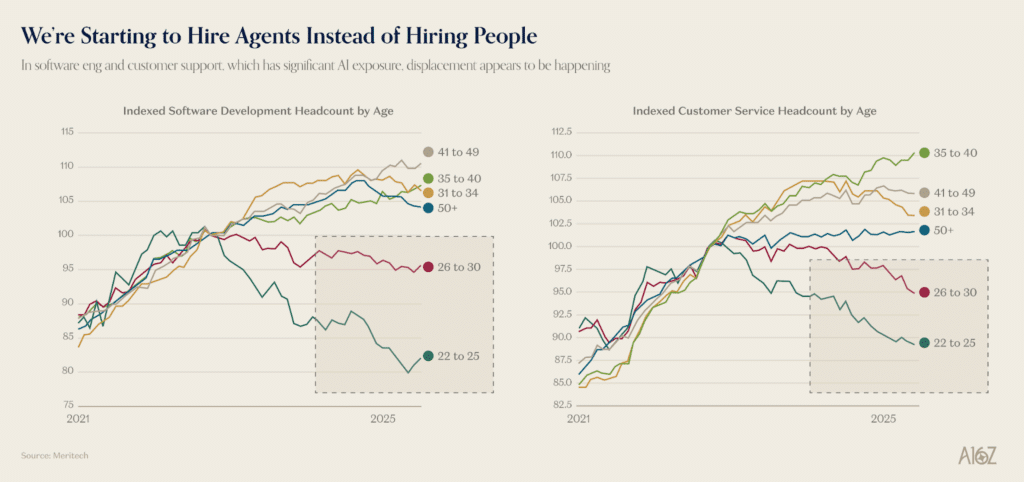
By 2026, the proliferation and rapid improvement of artificial intelligence will accelerate the disruption of work, particularly in roles that involve routine cognitive tasks. Evidence is already emerging in software development and customer support, where firms are increasingly deploying AI agents instead of expanding human headcount. Recent workforce data shows that hiring growth is concentrating among older, more experienced cohorts, while employment among younger workers is stagnating or declining. This shift suggests that organizations are beginning to treat AI as a substitute for entry-level labor rather than a complement to it.
Source: a16z newsletter
As AI systems become cheaper, more reliable, and easier to deploy, firms will increasingly “hire” agents to handle coding, testing, support, and analysis tasks that once served as on-ramps to careers. The saving grace here is if AI is able to voyage into oceans of nonconsumption. This has the potential to create new types of work, some of which are unknown to us today.
The uncomfortable truth is that while AI lowers the technical barriers to starting a business, it also removes the structured environments where many people learned how to build one. As firms replace junior roles with AI, fewer aspiring entrepreneurs will gain experience inside organizations that teach discipline, customer understanding, and operational rigor. Many will start companies earlier, but with thinner managerial foundations, increasing the odds of fragile and short-lived ventures.
On entrepreneurship: In 2026, cheaper and more standardized AI tools, combined with growing job displacement, will push more people into entrepreneurship by lowering the cost, skill, and capital required to start a business.
Theory Used: Modularity Theory
Modularity theory explains that when performance is scarce, systems must be tightly integrated and interdependent, but as performance becomes abundant and standardized, activities modularize, shifting power and opportunity to smaller, more flexible actors.
As AI tools become cheaper and more standardized, work will increasingly be organized into modular building blocks that individuals can assemble themselves. This will dramatically lower the cost, skill, and capital barriers to starting and scaling a business.
At the same time, as job displacement, especially from the proliferation of AI and economic uncertainty, pushes people out of stable roles, the supply of would-be entrepreneurs would increase. The caveat is that this is likely to fuel small-scale ventures.
The rise in entrepreneurship will not automatically translate into broad-based prosperity. Without new sources of demand, access to capital, and pathways to scale, many new ventures will simply compete with one another in crowded and low-margin markets.
The year ahead will not be defined by better intentions, but by tighter constraints. Development actors will have less money, workers will face fewer traditional entry points, and institutions will struggle to adapt at the pace technology demands.
In that environment, innovation and entrepreneurship will not be optional strategies. They will be the mechanisms through which systems either adjust or fail. Will leaders be willing to let go of familiar models fast enough to build what comes next?