Last week, I had the opportunity to present on Christensen’s theories of Disruptive Innovation at a med tech conference for entrepreneurs and innovators. The feedback I received made me realize the message could be useful to this community as well. So, if you’re an innovator or entrepreneur building to improve the future of health care, or an investor funding these ventures, I hope this will be useful to you.
Disruptive Innovation is among the most misunderstood and misused business terms. By Christensen’s definition, Disruptive Innovation is a theory of competitive response. When you understand if a product or service has disruptive potential, you can determine how both the demand and supply sides of the market will respond. Some believe disruption is also a strategy for success.
It’s not…at least not on its own.
Let’s look at two well-known examples of supposed disruption: Netflix and Uber. Most understand that Netflix was disruptive to Blockbuster: it entered at the bottom of the market with a lower-quality product (i.e., one had to wait days for the DVD to arrive in the mail) and unseated the leading incumbent. This is a classic story of Disruptive Innovation, and the process unfolded over about 10 years. There are three important lessons in this story: 1) Netflix’s business model disrupted Blockbuster’s business model; 2) Disruption is relative: Netflix was disruptive relative to Blockbuster; 3) Disruption is a process, not an event, and it often unfolds over years.
Many people mistake Uber for another disruptive innovation. It’s not. It didn’t enter the market on a disruptive trajectory: instead of offering a lower-quality, less expensive product to those excluded from the market or overserved by existing taxis, it offered a better product for existing taxi customers. Did it change the market? Yes. Did it disrupt the market? No.
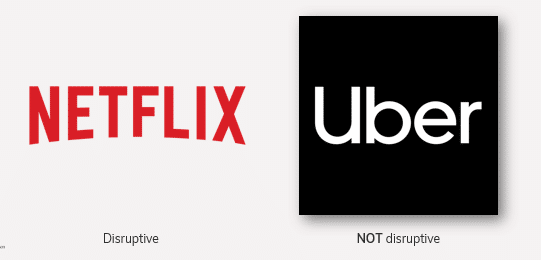
What Disruptive Innovation is: A theory to predict the market’s response to a new innovation
Whenever I present on this topic, I start with three truths:
- Disruptive Innovation is a theory of competitive response.
- Disruption enters through the basement door and relentlessly moves upmarket.
- Business models disrupt business models. Technology alone isn’t disruptive.
If you are familiar with Christensen’s work, you’ve likely seen the graphic below, which illustrates how disruptive innovations play out in the market.
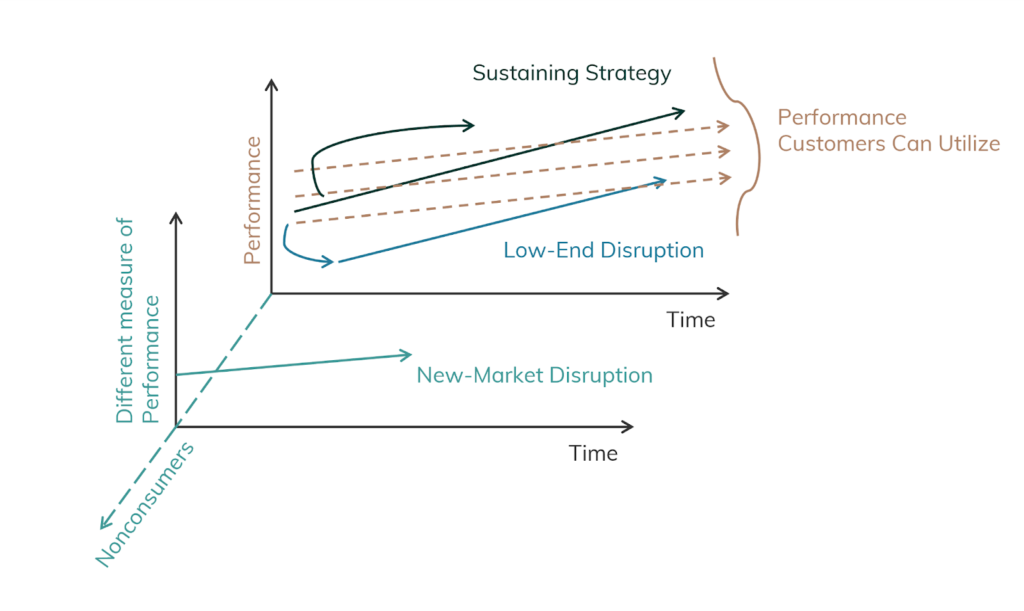
First, disruptive innovations can enter the market when existing solutions are too expensive or too hard to access. There are two types of disruptive innovations: low-end and new-market disruptions. Low-end disruptions enter the market with an inferior product or service, competing on lower cost or quality to serve customers overserved by the incumbent’s offerings (i.e., the first manual glucose monitors or Cost Plus Drugs). New-market disruptions serve prior nonconsumers, those who previously weren’t participating in the market at all (i.e., many online behavioral health offerings). Some innovations are hybrid disruptive innovations, meaning they possess characteristics of both low-end and new-market disruptions (i.e., Butterfly’s point-of-care ultrasound).
Sustaining innovations make good products better for an incumbent’s best customers. Most innovations inside and outside of health care are sustaining. Some examples include concierge primary care practices like PartnerMD and continuous glucose monitors.
Understanding whether you’re launching an innovation with disruptive potential, or one that is sustaining, matters because it determines how the market (both incumbent suppliers and customers) is likely to respond and who’s more likely to win.
When startups enter at the bottom of the market and compete on a disruptive trajectory, incumbents are likely to ignore them, at first. But if startups enter the market and compete in a sustaining innovation fight—by offering a better product that serves incumbents’ best customers—incumbents will fight back, and they most often win. This is why disruption on its own isn’t an effective strategy. Context matters.
What Disruptive Innovation isn’t: A strategy for success
Christensen didn’t intend for disruption to be synonymous with success. It was meant to explain a competitive process. Powered by an innovative business model, potential disruptions relentlessly move upmarket, capturing market share and lowering costs along the way. This ultimately allows new entrants to topple incumbents who ignored the startup’s initial entry and mistook the new offering as not good enough to take away their profitable customers.
Companies don’t succeed just because they pursue disruption. They’re called disruptive because of how they succeed.
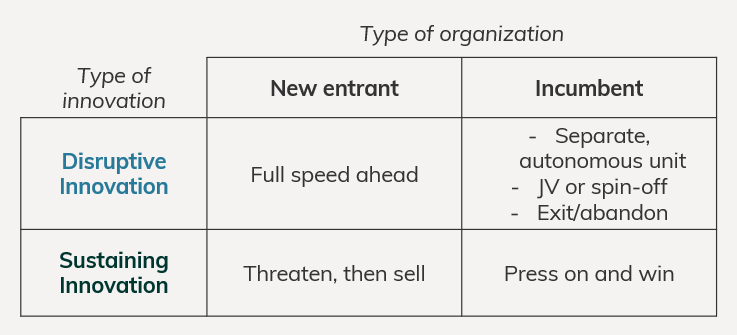
While disruption alone isn’t a strategy, whether or not you’re entering the market with a potentially disruptive innovation does inform your strategy. In addition to the type of innovation you’re launching, the type of company you’re launching it from within is a critical context. The strategy with which you compete is informed by the intersection of the type of innovation you’re launching and the type of company you’re working within. See the matrix below for an explanation:
Source: Adapted from an HBS Executive Education slide
The reason the type of company matters is that a business model’s priorities determine which innovations it can and will pursue, and which ones will succeed. If you want to launch a disruptive innovation from within an incumbent organization (the upper-right-hand corner of the matrix above), your strategy needs to include setting up the new product or service in a fully separate business unit (ABU or Autonomous Business Unit). This new unit must be able to operate with a fully autonomous business model that isn’t tied to the core organization. Alternatively, you can set up a joint venture or spin it off. Or, you can acknowledge that your business model constraints won’t allow it to succeed, and you can abandon the effort.
But if you’re a startup launching a disruptive innovation, you have a lot more latitude in how you develop your strategy and seek to compete in the market. You are poised to win because incumbents are likely to ignore your initial efforts.
So, while disruption isn’t a strategy for success on its own, it helps innovators understand how the market is likely to respond to their new offering, plus the context they need to consider to develop an effective innovation strategy.