Summary:
- Banning cellphones in schools may feel like common sense, but statewide blanket bans risk undermining both learning and innovation.
- While phones often distract students, some educators are using them intentionally to increase engagement and improve outcomes.
- The smarter path is to empower schools—not policymakers—to decide when phones should be banned and when they should be used to support learning.
As states around the country have passed legislation banning cellphones in schools, Massachusetts legislators are considering following suit.
Although smartphones are likely detrimental to many students’ mental health and ability to stay engaged and learn during class, passing a statewide ban would be a mistake.
The reason departs from conventional wisdom. Even as disengagement in schools has soared in recent years, some teachers have also taken advantage of the advancing capabilities of phones to redesign their classrooms and reengage students with educational applications.
To be clear, according to anecdotes and early research, this appears to be far from the majority.
In traditional classrooms where students are expected to keep their eyes on the front of the classroom and follow the teacher’s lesson plan in lockstep, student cellphones present at least two challenges: disruption when students use their phones for non-academic purposes and distraction when students’ attentions are diverted by alerts and toggling between different apps.
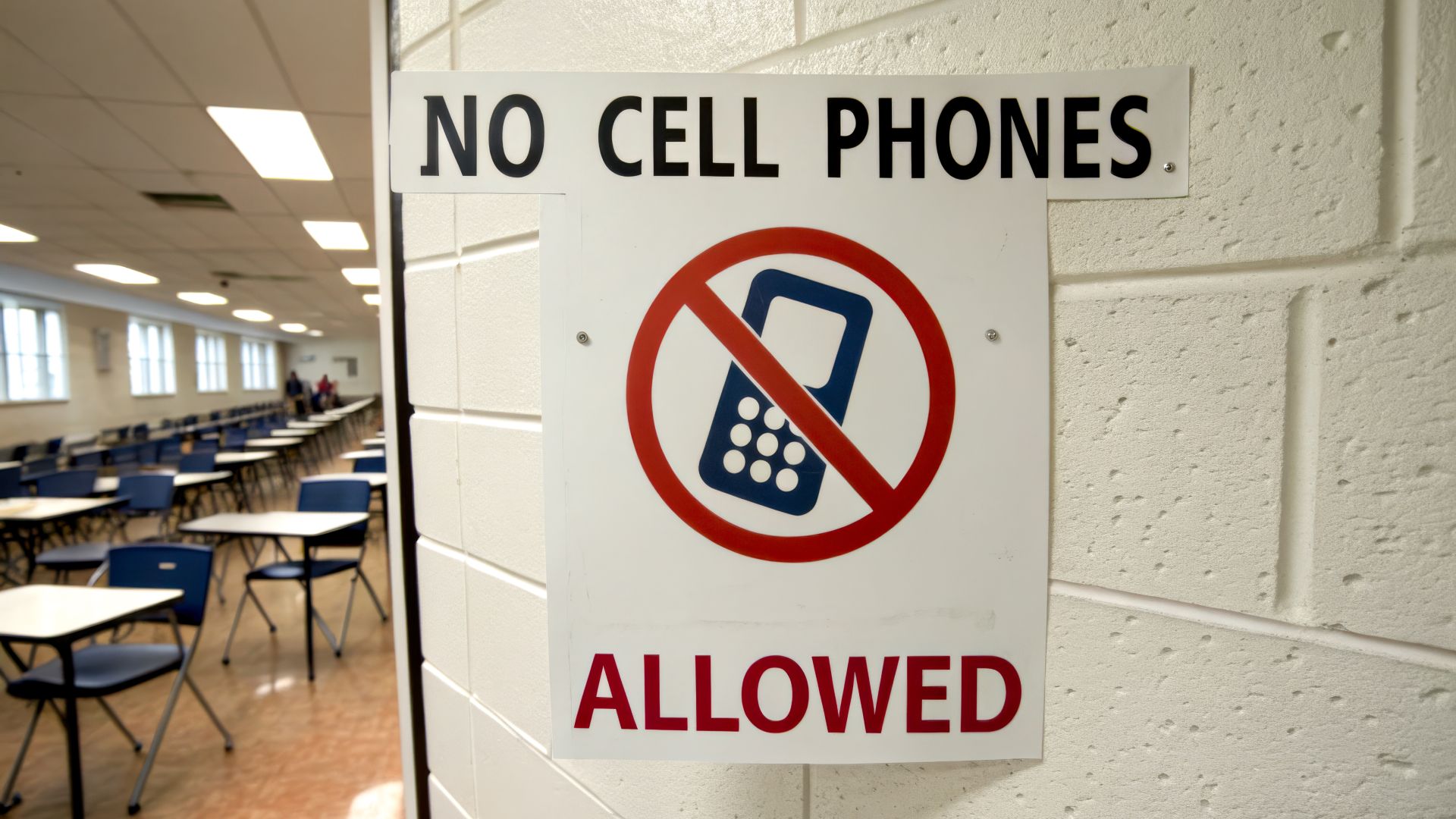
These reasons make it critical that educators are empowered to ban phones from classrooms and schools where their hallway use can provoke fights and other anti-social behavior. Schools should have the infrastructure and the legal clarity to be able to use their resources to purchase pouches or lockers and store smartphones in them.
Although some parents fear they won’t be able to get in touch with their children in case of emergency, the incidence of school violence is statistically small enough that educators should be able to determine when the harms from disengagement outweigh the risks of not being in touch—and when exceptions make sense.
In my own classroom at Harvard’s Graduate School of Education, I don’t allow students to use phones during most of class. That’s because I teach using case studies and the Socratic method. I expect all students to participate in a group discussion to deepen their understanding of an innovation theory by working through a specific situation. If students are instead paying attention to their devices, the conversation suffers, and student learning slows.
I’m not absolute
I leverage my students’ devices at key junctures in class to do checks for understanding of foundational concepts or to take polls to understand where we have differing viewpoints that we should dig into.
That flexibility and intentional use have helped improve my teaching and student learning. It’s what I hear from some other educators as well, who are taking advantage of smartphones to reengage students.
“[It] allows the teacher some real-time data,” said Uric Shannon, the Chicago executive director of the Surge Institute, which works with Black, Brown, and Hispanic K–12 educators.
In essence, when mobile phones can create a more active-learning environment, some educators have found it worthwhile to redesign their classrooms to take advantage of them.
And phones are sometimes a better solution than laptops, Shannon said. “Just using your phone as opposed to asking a group of kids to find that laptop” is far more efficient, Shannon argues, as long as it’s done with intent.
Share
Sometimes that’s to take advantage of the explosion in learning applications for mobile devices.
Think of apps like Duolingo or Speak for learning a language, for example. Given that students start in vastly different places in their learning and therefore aren’t ready to learn the same things on the same day, these apps can enable students to stay more engaged and on task—an improvement over the required foreign language labs some of us had in college, for example. And then there are times to silence the phones and talk with peers and the teacher in group conversations.
Lawmakers and phone skeptics will be quick to note that most bans have an exception for educational uses. But that’s a judgment call.
It’s not hard to imagine how that could get messy fast, as people outside a classroom debate a teacher’s use of a particular application.
Although it’s important that parents have a say in their children’s education, creating a policy that presumes the use of phones is illegal is tricky business. It will discourage enterprising educators from productively using new apps to drive learning gains.
What’s more, early research on cellphone bans has shown only small gains on average, and a few negative consequences. The average gains even masked some declines. For example, one study in India that showed paltry gains and attracted media attention also found negative but statistically insignificant declines for second-year students and no impact on STEM majors.
A better way forward is to have policy focus on the student outcomes and choices we desire, and then empower educators far more than we do today to shape the inputs that meet those ends.
So yes, that means clarity: schools can choose to ban phones, and they have the infrastructure and wherewithal to make it happen. But it doesn’t mean a top-down blanket ban either.