Summary:
- African governments face massive healthcare funding gaps, making innovation essential for access and affordability.
- Local companies (like Advantage Health Africa, Zuri Health, and MYDAWA) are scaling digital distribution, telemedicine, and lower-cost pharmacy models.
- Programs like the i3 initiative are supporting local solutions that expand access to essential medicines and services.
- To truly improve systems and meet universal coverage goals, philanthropists and development capital must back these innovators.
Innovators are building the foundations of affordable healthcare in Africa
In 2026, leaders in philanthropy, development finance, and multilateral development institutions must help them scale.
All UN member states have agreed to try and achieve universal health coverage (UHC) by 2030, with 50 African countries in various phases of implementation. Healthcare is increasingly recognized as a human right. Yet African governments struggle to fund healthcare at scale. Healthcare might be a human right, but it is neither free nor costless. In fact, it is incredibly expensive.
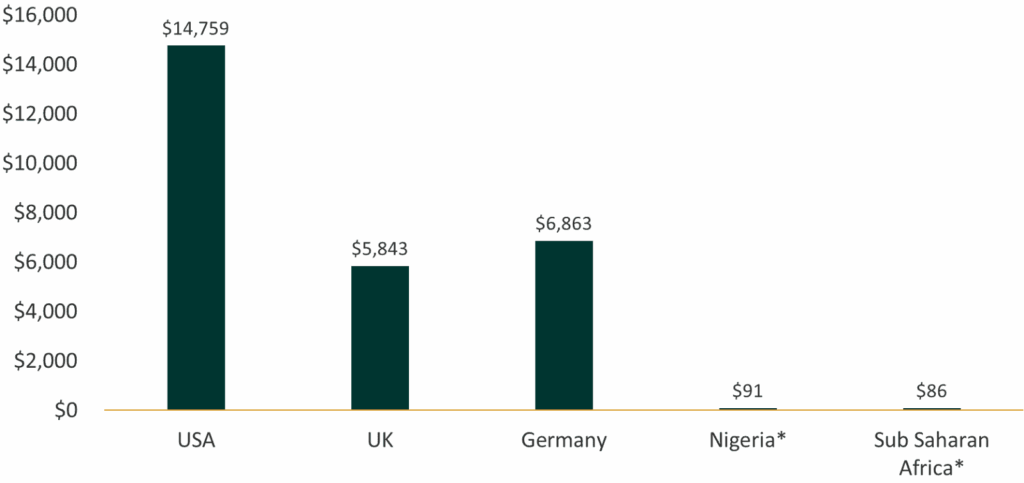
Healthcare spending per capita, 2024 (Select countries)
Sources: OECD, African Health Observatory, World Bank
*Nigeria and SSA’s updated 2025 reports cite data from 2022
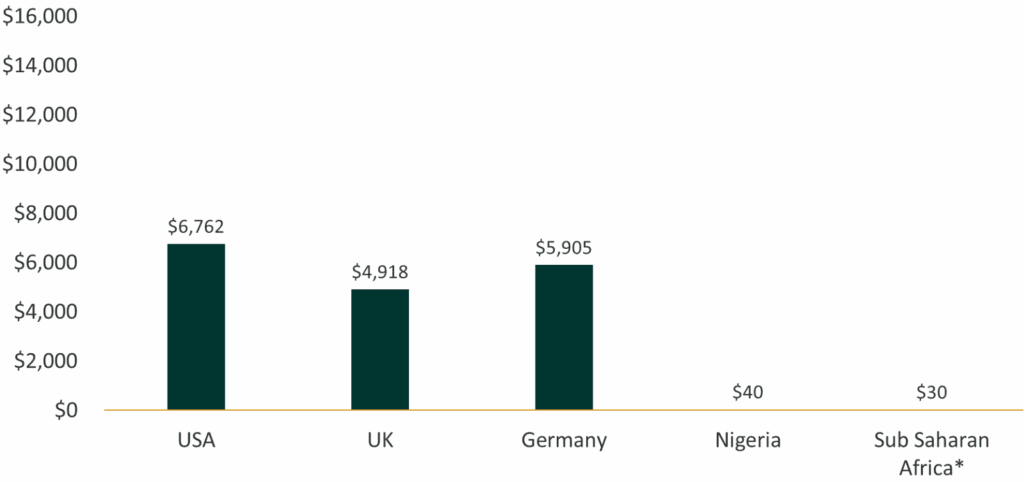
Government healthcare spending per capita, 2024 (Select countries)
Sources: KFF, UK Census, Country Economy, African Health Observatory, World Health Organization
*Sub Saharan data is from a 2023 WHO report
Healthcare expenditure per capita in the United States is almost $15,000 and about $7,000 in Germany. In Nigeria, it is closer to $100; across Sub Saharan Africa, roughly $90.
In most countries, the government is the largest single payer for healthcare. Of the entire healthcare expenditure in the United States, the U.K., and Germany, the government is responsible for approximately 46%, 84%, and 86% respectively. In Nigeria and Sub Saharan Africa, the percentage hovers around 44% and 35% respectively. Given that African governments spend two orders of magnitude less per capita on healthcare, productivity gains in the sector must come from innovators—not public budgets alone.
The moment to support innovators is now
2025 began with the dismantling of the United States Agency for International Development (USAID) and much of the global health infrastructure it had built over decades. Millions of people lost access to medicines, tens of thousands lost jobs, and lives were lost as a result. At the same time, the UK, Germany, and many other wealthy nations have cut aid budgets, sending a clear signal that poor countries were no longer a priority.
Yet in this moment of cuts and crisis, African healthcare innovators are demonstrating remarkable resilience. Many are developing solutions actively and sustainably expanding access to essential medicines, and other healthcare services.
Take Advantage Health Africa operating in Nigeria, for example. The company has built a hybrid digital health and technology-driven pharmaceutical distribution platform, delivering nearly two million products to customers.
Or consider Zuri Health, a virtual hospital and full-service telemedicine platform that is delivering on-demand care through its mobile app, website, WhatsApp, chatbot and SMS channels. The company has reached more than three million patients and currently works with international organizations such as Boehringer Ingelheim, Bayer, MTN, and Safaricom.
Then there’s MYDAWA, which operates one of Africa’s most sophisticated “bricks and clicks” pharmacy and primary health models. MYDAWA has served more than 1.2 million patients directly in Kenya and Uganda. The company’s model allows it to offer its products for up to 30% less than others on the market.
These companies, and many others, are part of the Investing in Innovations (i3) program sponsored by the Gates Foundation, MSD, Endless Health, Cencora, Help Logistics, Sanofi, and Boehringer Ingelheim. (I serve as the chair of the steering committee for the i3 program). The i3 program is redefining how Africa solves its healthcare challenges. Instead of waiting for solutions, the program is investing in local innovators who are developing context specific solutions to the challenges on the ground.
Across Africa, thousands of innovators are working hard to develop solutions that make healthcare products and services affordable to millions of people on the continent. These innovators are working in environments starved of capital, yet they continue to build, driven by a deep conviction that no one is coming to solve these problems for them.
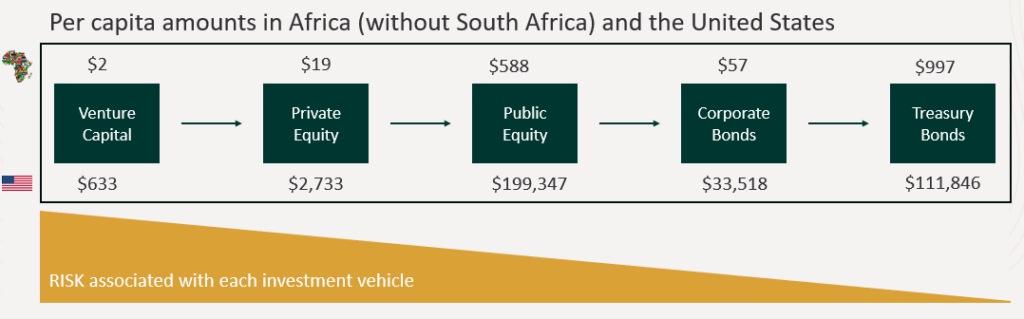
Africa and US sources: Venture Capital in Africa Report, NVCA, Statista, Statista, VerivAfrica, SiblisResearch, ICMA* (2020), Group SIFMA, UN Trade & Development* (2022), Fiscal Data; South Africa sources: Statista, Statista, Statista, ABSA Corporate and Investment Banking, Trading Economics
For these innovators to have a fighting chance, philanthropists, development finance institutions, and other capital providers must support them.
To support the efforts of these innovators, the team at Unlock Aid has built a Solutions Index, “a new reference tool for donors, policymakers, and partners seeking the most promising organizations delivering results across global health supply chains and beyond.”
The biggest lesson I learned in 2025 was that the Prosperity Paradox is real. Economies will not prosper as a result of foreign aid. Instead, it is strategic investments in market-creating innovations which will propel them from poverty to prosperity. These innovators are creating new markets for healthcare products and services. If we want to see progress, we’ll provide them with the necessary capital, networks, and insights to scale.