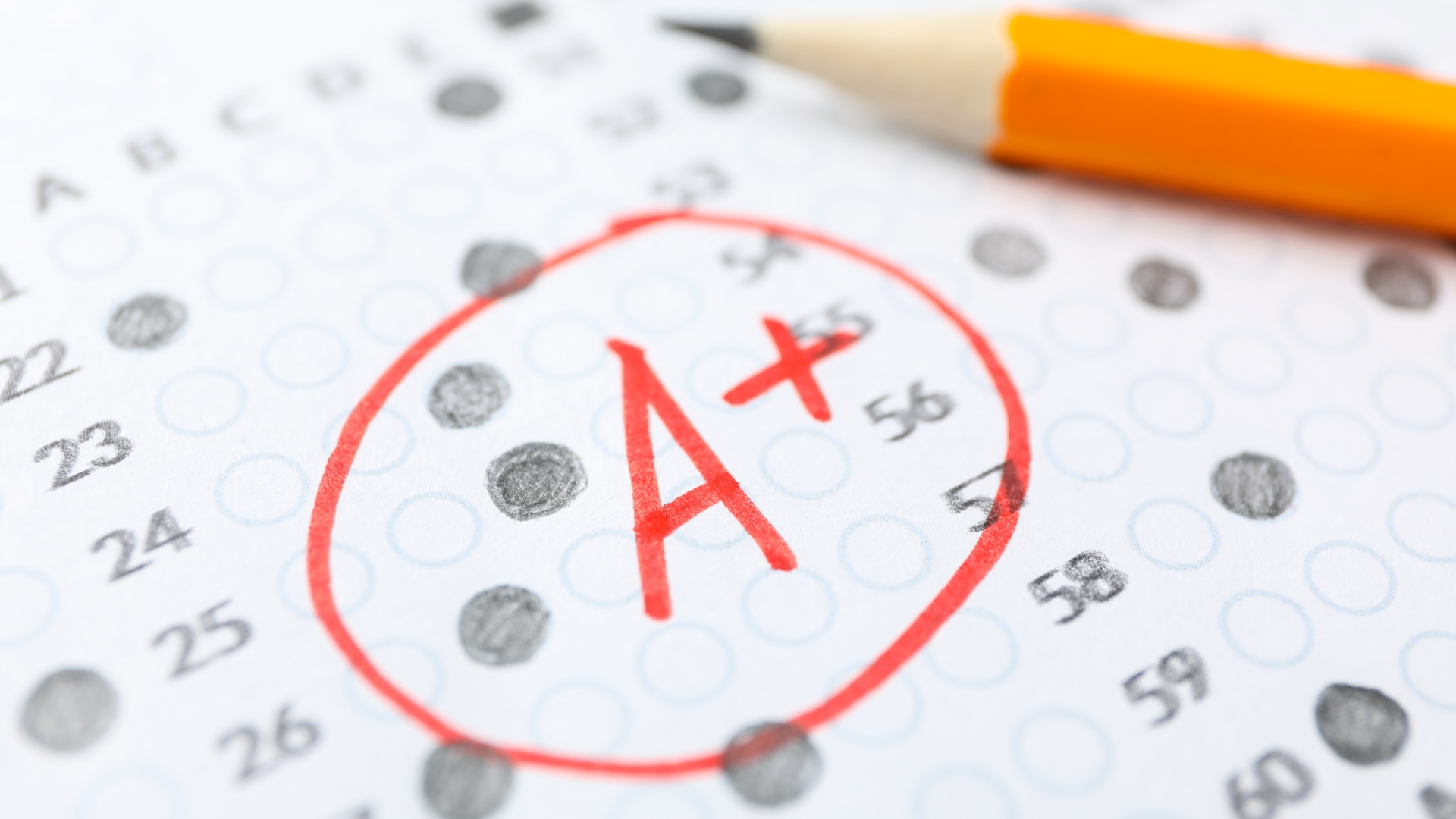
Anger is mounting as grades in high school and college soar.
According to the Department of Education’s National Center for Education Statistics (NCES), the average high school GPA soared from 2.68 in 1990 to 3.11 in 2019. According to an ACT study, grades kept climbing from there, as the three-year period between 2018 and 2021 saw more grade inflation than the preceding eight years.
As reported pretty much everywhere, a recent Harvard report found that undergraduate grades have soared at Harvard over the past two decades. More than 60% of grades were A’s in the 2024-25 academic year—up from about 25% two decades ago. At Yale, nearly 80% of undergraduate grades are A’s or A-minuses. And according to NCES, the median college GPA more generally rose by 21.5% between 1990 and 2020.
One might think this sounds good. We want students to learn more. Higher grades suggest they are doing so.
But as has been repeatedly shown, the problem is that it appears students are actually learning less—and that grades are simply becoming a less reliable signal.
As has now also been reported pretty much everywhere, a recent UC San Diego “Senate-Admissions Workgroup on Admissions” reported:
“Between 2020 and 2025, the number of freshmen whose math placement exam results indicate they do not meet middle school standards grew nearly thirtyfold, despite almost all of these students having taken beyond the minimum UCOP required math curriculum, and many with high grades. In the 2025 incoming class, this group constitutes roughly one-eighth of our entire entering cohort.”
As an example of a middle school problem, 25% of students couldn’t figure out that a “3” should go in the box as the answer to this problem on the test:
7 + 2 = [_] + 6
Further evidence that grades increasingly don’t connect to actual learning can be seen in the corresponding crash in the nation’s report card outcomes—the National Assessment of Educational Progress (NAEP) scores—over the last decade-plus, as well as the decline or stagnation in ACT and SAT scores.
What to do about a world in which grades are increasingly meaningless?
Well, for starters, teachers should stop grading their students.
That statement might cause its own freakout, because we just assume that grading is a core part of what teachers do.
But as I argued in my 2022 book From Reopen to Reinvent, being graded by your teachers doesn’t make much sense.
For starters, it creates a clear conflict of interest in the teacher role, where teachers are supposed to simultaneously be supporting, coaching, and teaching them, as well as judging them.
One reason standardized tests have historically remained a part of education is that they serve as a check on teachers going easy on their students. To be clear, moving to a mastery-based learning system, something for which I advocate, doesn’t inherently fix this dynamic. It might even exacerbate it because the incentives for inflating reports of student mastery could conceivably grow.
What’s more, when teachers grade their own students, the level of inconsistency between classes is high, such that letter grades don’t accurately represent what someone knows and can do.
Even worse when considering grade inflation, students sometimes earn an A because of the extra-credit work they did, which may or may not have anything to do with their mastery of the subject. The traditional grading system often takes into account other factors besides the academic standards in play, like behavior or tardiness
As Diane Tavenner wrote in her book Prepared: What Kids Need for a Fulfilled Life, “Grades offer little in the way of objectivity, as two-thirds of teachers acknowledge their grading reflects progress, effort, and participation in class.”
At one talk I gave to a prominent teachers’ organization, one member confided that this trend is increasing. Teachers worry about failing students for doing little work, the member said. They instead want to make sure students receive some credit for the nonacademic elements that schools should help cultivate in students.
What to do about it?
In higher education, Western Governors University (WGU) has illuminated one pathway forward. WGU is the largest online, competency-based university in America, serving well over 200,000 learners. Founded in 1997, the university embraces the unbundling of the teacher role with a five-part faculty model.
There are three student-facing faculty roles:
1. Program mentors, who are assigned to a student upon enrollment and support that student all the way through graduation with a variety of non-academic supports;
2. Instructors, who are subject-matter experts providing proactive and reactive academic support to students;
3. And evaluators, who review assessments to see if students have demonstrated mastery.
There are also two faculty roles that are behind the scenes: assessment faculty, who are experts in creating a variety of high-quality, valid, and reliable assessments, and curriculum faculty, who are experts in curriculum development and the science of learning.
Having a separate staff of impartial evaluators allows WGU to accomplish a few specific things for students.
First, students can never say they received a bad grade because their teacher didn’t like them. That’s because the faculty doing the grading doesn’t know them. It removes the conflict of interest, in other words.
Second, WGU can protect against grade inflation and, more generally, different grading practices among faculty members. It does so by having multiple faculty members grade a subset of work to establish interrater reliability. The University also invests in training its evaluators in the science of assessment—a skill that receives short shrift for most teachers. Because its evaluators specialize, they’re able to spend more of their time on acquiring these skills and perfecting their craft. As a result, although WGU uses some assessments that are automated and computer-scored, WGU’s most significant assessments are robust performance tasks rather than narrow measures that look like those that would appear on a standardized test and be the subject of educators’ scorn. Thanks to AI, it’s likely that WGU will be offering many more robust performance assessments that AI itself can score.
On the face of it, implementing this in K–12 school districts would seem to be much more difficult. Some districts only have one teacher for a given subject or grade level, which means that districts would have to create or join systems and agreements with other districts around how to use other teachers to grade their students. That would in turn mean that districts would need some agreement on the competencies to master, which assessments to use (which would mean schools that partner must be using similar curricula that focus on similar content knowledge), the rubric through which to grade students, and what level of work constitutes what corresponding grade—or, better yet, demonstrates mastery.
Yet there are hopeful signs ahead. AI could play a role in scoring richer assessments that are valid, reliable, and on-demand. And good, reliable, independent, third-party assessments do exist to measure mastery of math and the ability to read. The Carnegie Foundation for the Advancement of Teaching is working on creating its own alternative set of assessments with ETS that focuses on other skills. And the Khan Academy, through its tutoring platform Schoolhouse, offers assessments to certify mastery of certain concepts. It’s not hard to imagine the creation of more services that allow students to demonstrate mastery whenever they are ready for a variety of concepts, subjects, or tasks—and uses valid and reliable assessments that could be scored with humans and AI—and could allow students to showcase a much richer, more jagged, and more reliable view of what they’ve in fact learned. And the continued use of NAEP could help make sure these independent, third-party assessments don’t experience their own credential inflation or get tainted by student cheating.
So yes, standardized assessments will certainly help in rectifying runaway grade inflation. But a better solution is to stop teachers from doing the grading in the first place, creating a more objective, clearer, and less conflict-ridden system.